From Underground Culture to Academy: Highlights of the day.
Last spring, Joaquim Viñes and I participated in the UniOulu Science Day. During the event, we held two sessions aimed at researchers and staff from the University of Oulu who wanted to gain a broader view of scientific communication.
My friend Joaquim is also a microbiologist. We met while studying at the Autonomous University of Barcelona. He has specialized in genome sequencing of antibiotic-resistant bacteria in both human and animal health through his PhD and postdoctoral research. He is also one of the co-authors of a paper currently being written for my PhD thesis.
In addition to science, we have many things in common. Like me, Quim has been interested in different expressions of art, taking illustration, singing, or improv classes and creating loads of art when inspired. I personally believe his interdisciplinary background is one of the reasons he is now pursuing a career in education.
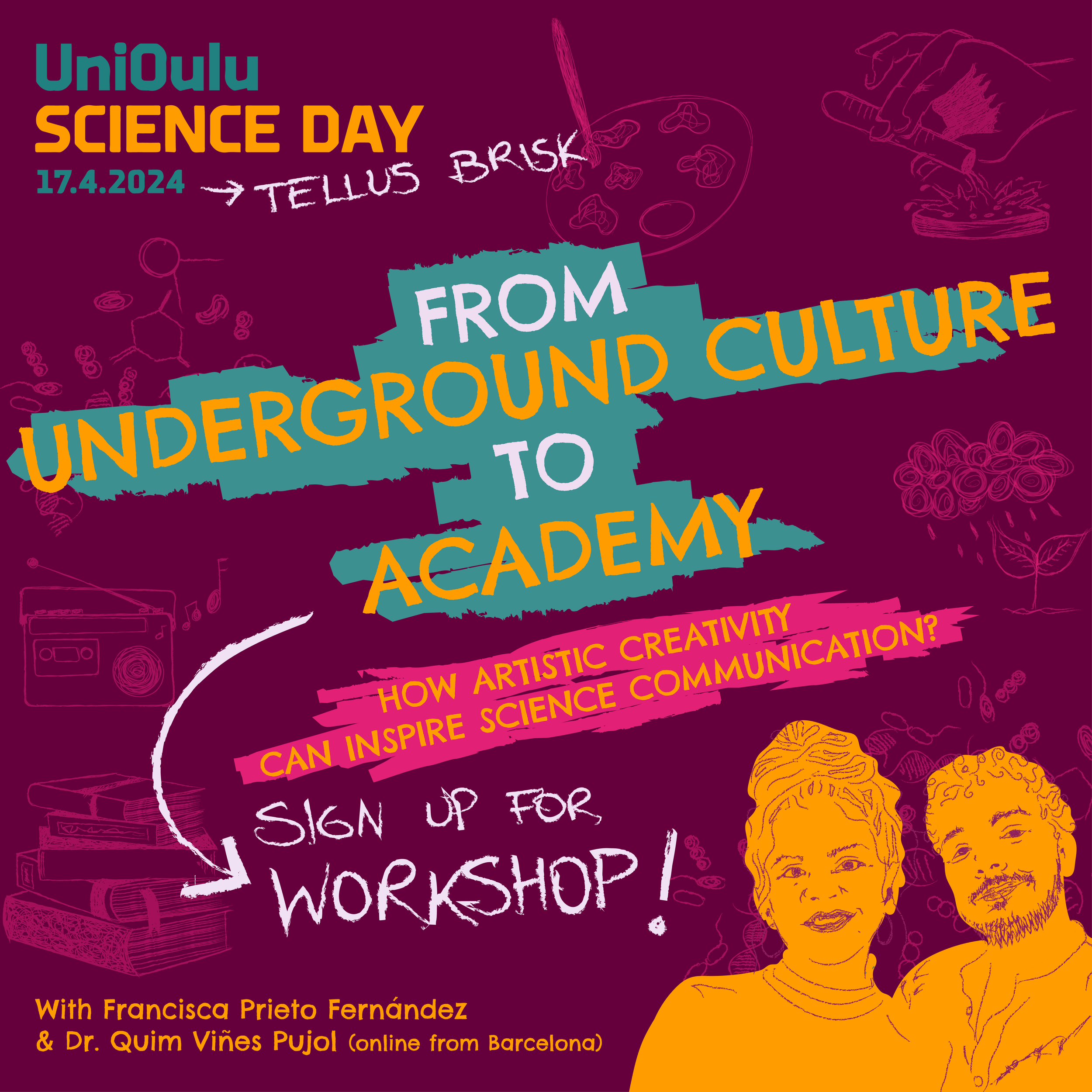
Poster used to promote the workshop.
In From Underground Culture to Academy,
we wanted to awaken the artistic and creative side of researchers by encouraging them to express their interests and use them to communicate science. Something I have learned from my life outside of work is that, in most cases, good events start with a good poster. So, we made our own. We were very happy to hear that around 30 people signed up in total.
Joaquim provided a theoretical background on scientific communication, explaining that academic knowledge usually remains within only a portion of society. For instance, he highlighted the percentage of people with tertiary education does not represent half of the population in most European countries. This is why the concept of scientific communication—the practice of informing science-related topics, and engaging with audiences that include, at least in part, people from outside the scientific community—is essential.
The case study of Pokémon
One example Joaquim gave, which I felt resonated the most with the audience, was the case study of Pokémon. Pokémon regions are heavily inspired by real locations and, as such, can be used to explain environmental phenomena such as climate change. For example, the Pokémon Corsola from Johto (2nd generation, 1999, inspired by Japanese villages) changed its color from pink to white in Corsola of Galar and Cursola (8th generation, 2019, inspired by Great Britain and industrial revolution), reflecting coral bleaching as a result of human-caused pollution.

Slide from Joaquim’s presentation.
Scientific communication as a political act
During my part of the session, I focused on the personal values in sharing academic knowledge. For example, we talked about using scientific communication as a political act. I explained that science communication should be seen as a symbiosis, benefiting both academia and the general public.
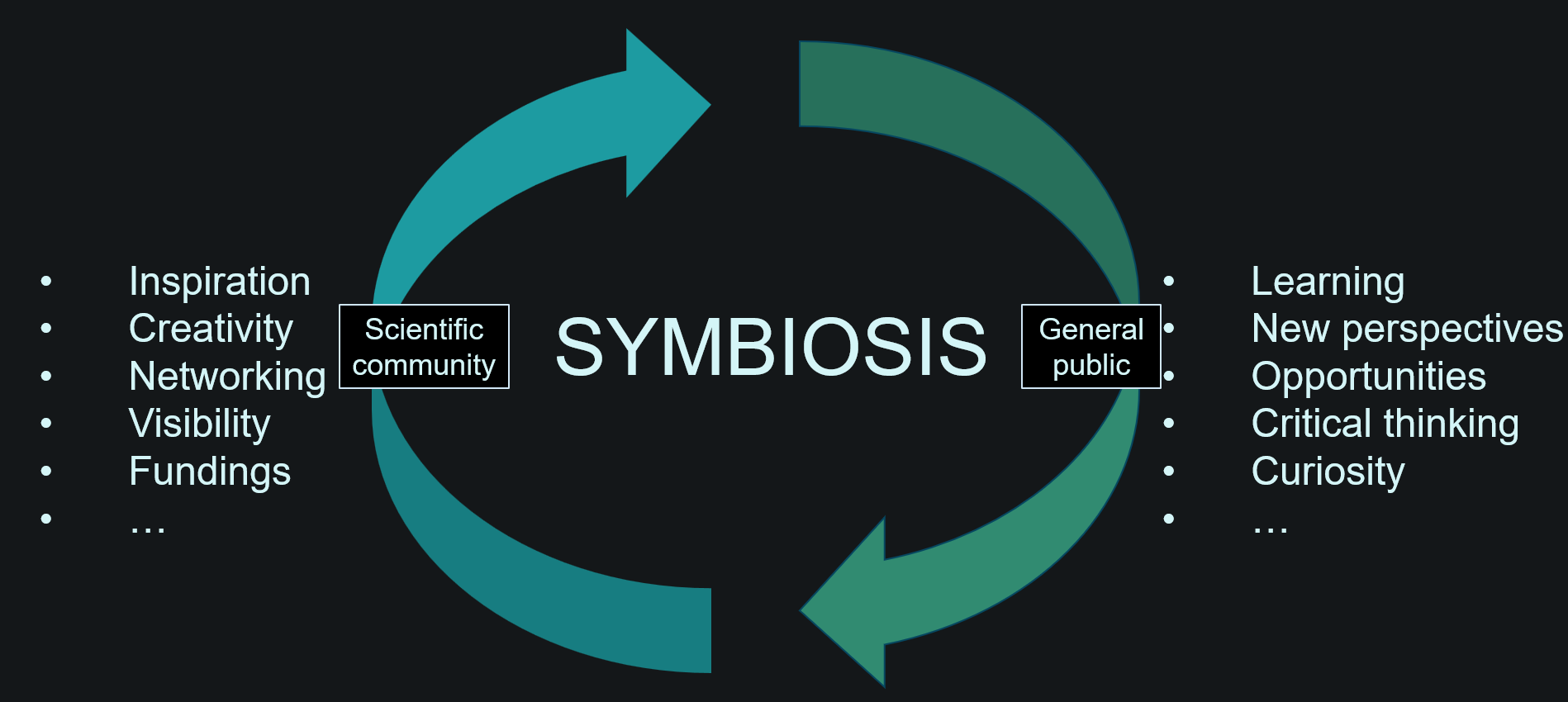
Scientific communication is a symbiosis process. With elements from Chappell, C. R., and Muglia, L. J. (2023). Fostering science–art collaborations: A toolbox of resources.
I also gave practical examples of scientific communication projects I have participated before. I shared some of my work, such as the stickers and interviews for the university magazine. Then, we discussed in detail the creative process behind the creation of my book.
For the second half of the workshop
Participants were encouraged to create some form of outreach work to share with the group. I remember some researchers presenting comic ideas, while others had been thinking about making music. Overall, it was a very inspiring session.
By the end of the day
We were both very happy with how the workshop turned out. We spoke with participants after the event, who expressed their gratitude and, most importantly, their motivation to work on their own projects. Nevertheless, the main takeaway for me was the passion researchers have for their subject and the need to find a channel to share it with others.